The first few days in Australia feel exciting. New campus. New city. New currency. Even buying groceries feels like an experience. Then the bills start arriving. Rent. Transport. Mobile recharge. Food. Coffee that somehow costs more than expected.
That is when most students begin searching for part time jobs in Australia for international students salary information. They want to know how much they can earn, which jobs are easier to find, and whether part-time income can cover everyday expenses.
The honest answer?
A part-time job can help a lot.
But it may not pay your entire tuition fee. And it may not appear during your first week either. Students need practical expectations. Not social-media promises.
This guide explains student work hours, current pay rates, popular jobs, expected salaries and the mistakes international students should avoid while working in Australia in 2026.
Can International Students Work in Australia?
Yes.
Most international students holding a valid Student visa, subclass 500, can work while studying.
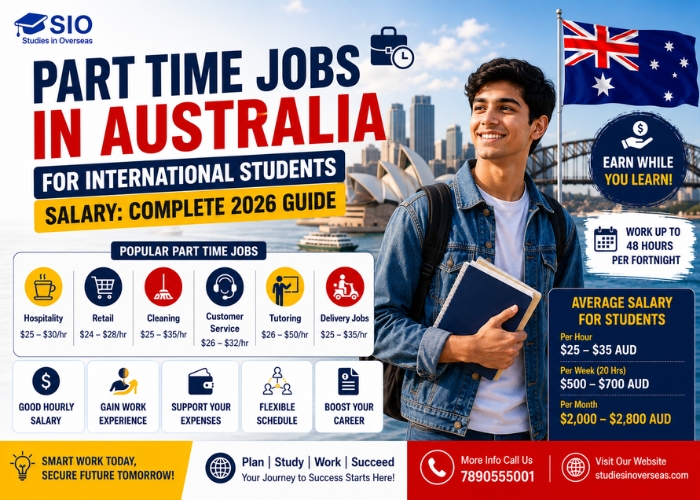
The standard limit is up to 48 hours per fortnight when the course is in session. In simple language, that is an average of 24 hours per week. You can distribute those hours differently.
For example, you might work 18 hours in one week and 30 hours in the next. The combined total must remain within your permitted fortnightly limit. During officially scheduled course breaks, students can generally work unlimited hours.
There is also an exception for students who have started a master’s degree by research or a doctoral degree. Their work-hour conditions may be different. Still, always check your personal visa conditions through VEVO. Do not assume. Visa conditions are not the place for guesswork.
What Is the Minimum Wage in Australia in 2026?
From 1 July 2026, Australia’s National Minimum Wage is AUD 26.44 per hour for eligible adult employees not covered by another award or registered agreement. For an eligible casual worker under the National Minimum Wage, the rate is AUD 33.05 per hour because casual workers generally receive a 25% casual loading.
Sounds great. But there is a detail.
Many student jobs are covered by industry awards. Retail, hospitality, fast food, cleaning and other industries may have their own classifications, penalty rates and allowances.
Your actual pay depends on:
- Your age
- Your employment type
- Your job classification
- The industry award
- Your shift timing
- Whether you work weekends or public holidays
- Your experience and responsibilities
So, the minimum wage in Australia for international students is not one identical number for every job. Check the correct award before accepting an offer.
How Much Can an International Student Earn Per Month?
Let’s do a basic calculation.
If a student works 24 hours each week at AUD 26.44 per hour, the gross earnings may be approximately:
- AUD 634.56 per week
- AUD 1,269.12 per fortnight
- AUD 2,749.76 per month
This is before tax.
If an eligible casual worker earns AUD 33.05 per hour and receives 24 hours of work each week, the gross amount may be approximately:
- AUD 793.20 per week
- AUD 1,586.40 per fortnight
- AUD 3,437.20 per month
Again, before tax. Looks impressive on paper. But casual workers may not receive guaranteed hours. One week you might get 24 hours. The next week, only 12.
That is why part time jobs in Australia for international students salary estimates should never be treated as guaranteed monthly income. Shifts change. Exams happen. Businesses become quiet. Life does its thing.
Popular Part-Time Jobs and Expected Salaries
Pay varies by city, employer, award and shift. The following ranges are broad 2026 planning estimates, not guaranteed offers.
| Part-time role | Indicative hourly salary |
|---|---|
| Retail assistant | AUD 27–35 |
| Barista or café worker | AUD 27–36 |
| Waitstaff or kitchen hand | AUD 27–36 |
| Cleaner | AUD 33–61 depending on shift and award |
| Warehouse assistant | AUD 30–40 |
| Customer service assistant | AUD 28–38 |
| Administrative assistant | AUD 28–38 |
| Academic tutor | AUD 34–50+ |
| Aged-care support worker | AUD 32–45 |
| Delivery worker | AUD 25–35 before personal expenses |
| Campus assistant | AUD 28–35 |
| Freelance designer or writer | AUD 30–60 depending on skill |
These figures can change.
Weekend and public-holiday shifts may pay more. Experienced workers may also receive better rates. Certain roles need licences, certificates or background checks. Now, let’s understand the jobs properly.
1. Retail Assistant
Retail work is one of the most common part time jobs in Australia for international students.
Students may work in:
- Supermarkets
- Clothing stores
- Department stores
- Electronics shops
- Pharmacies
- Convenience stores
The work usually involves helping customers, arranging stock, managing billing and keeping the store organized. Retail jobs are good for students who communicate confidently and enjoy interacting with people. Pay may commonly fall between AUD 27 and AUD 35 per hour, depending on age, employment type, award classification and shift.
Weekend shifts can pay more.
The difficult part?
Competition.
Many students apply for the same roles, especially before Christmas and major sale periods. A clean one-page résumé helps. So does walking into smaller shops at the right time. Not during their busiest hour, though. Timing matters.
2. Barista and Café Jobs
Australia takes coffee seriously. Very seriously. Baristas, café all-rounders, dishwashers, kitchen hands and front-of-house workers are regularly hired on casual or part-time arrangements.
A beginner may start by:
- Clearing tables
- Taking order
- Washing dishes
- Preparing simple food
- Managing takeaway orders
Experienced baristas can earn more because coffee-making skills are valued.
The part time job salary in Australia for hospitality work may range from around AUD 27 to AUD 36 per hour. Penalty rates may apply for late-night, weekend or public-holiday work.
Students with no experience can take a short barista course, but a certificate alone does not guarantee a job. Practice does. Employers want someone who can handle pressure when ten customers arrive together and all of them want different milk. That’s the real test.
3. Cleaning Jobs
Cleaning may not sound glamorous. But it can pay well. Students may clean offices, homes, hotels, schools, shopping centres or commercial buildings. The timings are often early morning, evening or weekends, which may fit around classes.
Under the Cleaning Award, an eligible casual Level 1 worker can receive different minimum rates depending on the day and shift. In 2026, weekday, Saturday and Sunday rates can vary significantly. This makes cleaning one of the potentially highest paying part time jobs in Australia for international students, especially when weekend penalty rates apply.
The job can be physically demanding. You may stand for long hours, lift equipment or travel between locations. Some employers also require a police check or previous experience. Never accept a suspiciously low flat cash rate without checking your legal entitlement. Cheap labour is not a student job opportunity. It is underpayment.
4. Warehouse and Pick-Packing Work
Warehouses often hire students for:
- Packing orders
- Sorting products
- Labelling items
- Loading stock
- Inventory assistance
- Online order fulfilment
Hourly earnings may commonly range between AUD 30 and AUD 40, depending on the shift, industry and responsibilities. Night shifts may offer higher rates. The work is practical. Sometimes tiring. You may need safety shoes, basic physical fitness and the ability to work quickly. Forklift roles usually require a licence and should not be treated as entry-level jobs without training. Warehouse work suits students who prefer less customer interaction. Just you, the scanner, the boxes and a very serious deadline.
5. Tutoring
Tutoring can be a strong option for students who are good at:
- Mathematics
- Science
- Coding
- English
- Accounting
- Test preparation
- School-level subjects
Tutors may work for coaching centres, online education companies or families. Current casual advertisements can offer around AUD 34 to AUD 50 per hour for general tutoring, while specialised subjects may pay more. This makes tutoring one of the highest paying part time jobs in Australia for international students with strong academic skills.
But getting consistent hours may take time. Parents and coaching centres want evidence that you can teach, not just score well yourself. Explaining a concept calmly is a separate skill. Knowing the answer is only half the job.
6. Customer Service and Administrative Work
Students with strong communication and computer skills can apply for:
- Reception work
- Data entry
- Call-centre roles
- Office assistance
- Customer support
- Appointment coordination
The expected salary may range from approximately AUD 28 to AUD 38 per hour. These jobs may offer more regular schedules than hospitality, but they can also be harder to secure without local experience. Knowledge of Microsoft Office, Google Workspace, customer relationship software or basic bookkeeping can help. For students studying business, marketing, finance or management, office work may also strengthen the résumé. That is valuable. You earn money and collect relevant experience together.
7. Aged-Care and Disability-Support Work
Australia has ongoing demand in care-related services. Students may find work as personal-care assistants, community-support workers or disability-support workers. However, these are responsible roles.
Depending on the position, you may need:
- Certificate III training
- Police clearance
- NDIS worker screening
- First-aid certification
- Vaccination evidence
- A driving licence
Hourly rates may fall around AUD 32 to AUD 45 or higher for certain shifts. Do not apply casually because the pay looks attractive. You are supporting real people. Patience, reliability and emotional maturity matter.
8. Delivery Jobs
Food and grocery delivery appears flexible. Log in. Accept orders. Earn money. Sounds simple. The reality is more complicated. Delivery workers may use a bicycle, electric bike, scooter or car. Earnings can change by location, demand, weather and platform.
You must also consider:
- Fuel
- Vehicle maintenance
- Insurance
- Mobile data
- Safety equipment
- Unpaid waiting time
Some delivery workers are treated as independent contractors rather than employees. That can change their legal entitlements and tax responsibilities. So, when comparing part time jobs in Australia for international students salary, do not look only at the amount shown per delivery. Calculate what remains after expenses. Gross income can look big. Net income tells the truth.
9. University and Campus Jobs
Universities may hire students as:
- Library assistants
- Student ambassadors
- Event helpers
- Administrative assistants
- Research assistants
- IT-support workers
- Peer mentors
Campus jobs are convenient because employers already understand academic schedules. They may also connect with your course. The problem is availability. Campus roles attract many applications, and vacancies may be limited. Students should regularly check their university career portal and attend employability events. Do not wait until your savings are almost finished. Apply early.
Can Part-Time Work Cover Tuition Fees?
Usually, no.
Part-time earnings can support:
- Groceries
- Transport
- Phone bills
- Personal expenses
- Part of the rent
But international tuition can cost tens of thousands of Australian dollars per year. Students should not build a financial plan where one part-time job must cover tuition, rent and every living expense. That plan is fragile. The international student salary Australia offers can make daily life easier, but it should not replace proper funding. A student might take three or four weeks to find work. Some take longer. Work hours may reduce during exams or quiet business periods. Arrive with enough money. Your job should support your education. Your education should not become secondary to your job.
A Small Story That Happens Quite Often
Imagine a student named Rohan. He arrives in Melbourne expecting to find work within seven days. He applies online. Nothing. He sends the same three-page résumé to 40 employers. Still nothing. Then he changes the approach.
He creates a one-page Australian-style résumé. He adds his actual availability. He visits local cafés outside peak hours. He asks his university career office to review his application. Two weeks later, he gets a weekend café job. Not perfect. But a start.
This is the reality of part time jobs in Australia for Indian students. The first job may take effort. After local experience and references, the second one often becomes easier. Patience helps. So does a better résumé.
How to Find a Part-Time Job Faster
Start with your university. Career teams often provide résumé reviews, interview workshops, employer events and job boards.
Then use:
- SEEK
- Indeed
- University career portals
- Local community groups
- Direct employer websites
- In-person applications to nearby businesses
Tell classmates and seniors you are looking. Networking is not begging. It is information moving between people. Keep your availability clear. Employers prefer students who know exactly when they can work. “Available anytime” sounds flexible. Until your class timetable arrives. Be honest from the beginning.
Documents You May Need Before Working
International students usually need:
- A valid visa with work rights
- Tax File Number
- Australian bank account
- Australian phone number
- Current résumé
- Proof of identity
- Relevant licences or certificates
Hospitality roles serving alcohol may require Responsible Service of Alcohol certification. Construction work may require a White Card. Care roles may require police checks or sector-specific screening. Do not buy every certificate before choosing the job type. That becomes expensive quickly. Select the industry first. Then complete what is actually required.
Understand Casual and Part-Time Employment
The words sound similar. They are not the same. Part-time employees generally have regular agreed hours and may receive paid leave entitlements. Casual workers usually have less predictable hours but often receive a higher hourly rate through casual loading. A high casual rate can look better. But guaranteed weekly income may be lower if shifts disappear.
When comparing the part time job salary in Australia, consider:
- Hourly pay
- Guaranteed hours
- Leave entitlement
- Weekend availability
- Travel time
- Late-night transport
- Shift cancellation risk
The highest hourly rate is not automatically the best job. A reliable workplace close to campus may save more money and stress.
Know Your Workplace Rights
International students have workplace protections in Australia. Your employer should provide a payslip. You are entitled to the correct minimum pay under the applicable award or agreement. Eligible workers may also receive employer superannuation contributions. Your employer cannot legally pay you less simply because you are an international student.
Watch for warning signs:
- Cash payments with no records
- No payslips
- Unpaid hours
- Pressure to exceed visa work limits
- Threats involving your visa
- Payment below legal rates
- Unsafe working conditions
Keep copies of rosters, messages, timesheets and payslips. Records matter. Especially when something goes wrong.
Common Mistakes Students Make
The first mistake is accepting the first job without checking the legal pay rate. The second is working more than the visa permits during study periods. The third is focusing so much on work that attendance and academic performance suffer. Another mistake is travelling two hours for a three-hour shift without calculating transport costs. Students also take unsafe late-night jobs without planning how to return home. And some believe every cash job is illegal.
Cash payment itself is not automatically illegal. The problem begins when earnings are hidden, records are missing, tax is avoided or the worker is underpaid. Be careful. Not fearful.
Frequently Asked Questions
1. How much can an international student earn in Australia in 2026?
An international student working an average of 24 hours per week at AUD 26.44 per hour could earn around AUD 2,749.76 per month before tax. Casual earnings may be higher, but the number of shifts is not guaranteed.
2. What are the highest paying part-time jobs for students in Australia?
Tutoring, cleaning with penalty rates, warehouse shifts, disability support and specialised freelance work can be among the highest paying part time jobs in Australia for international students. Qualifications, experience and shift timing affect the rate.
3. How many hours can international students work in Australia?
Most Student visa holders can work up to 48 hours per fortnight while their course is in session and unlimited hours during scheduled course breaks. Students should check their individual visa conditions through VEVO.
4. Can part-time jobs cover living expenses in Australia?
Part-time earnings can help with groceries, transport and part of the rent. However, income varies and jobs are not guaranteed. Students should not depend on part-time work to pay their complete tuition and living costs.
Conclusion
Part-time work can become an important part of student life in Australia.
You earn money.
You meet people.
You build confidence.
Sometimes you also learn how difficult customers can be before 8 a.m.
The part time jobs in Australia for international students salary depends on the role, industry award, age, shift and employment type. From 1 July 2026, the National Minimum Wage for eligible adult award-free employees is AUD 26.44 per hour, while eligible casual workers under that minimum receive AUD 33.05 per hour.
But salary is not the only thing.
Choose work that fits your class schedule. Check your visa conditions. Understand your workplace rights. Keep payslips and records.
Most importantly, stay realistic.
A part-time job can support the journey.
It should not control the whole journey.