The plan often begins with one simple conversation at home.
“Let’s check Australia.”
Then comes the university website. The course looks exciting. The campus looks beautiful. Everything feels possible. Until the fee page opens.
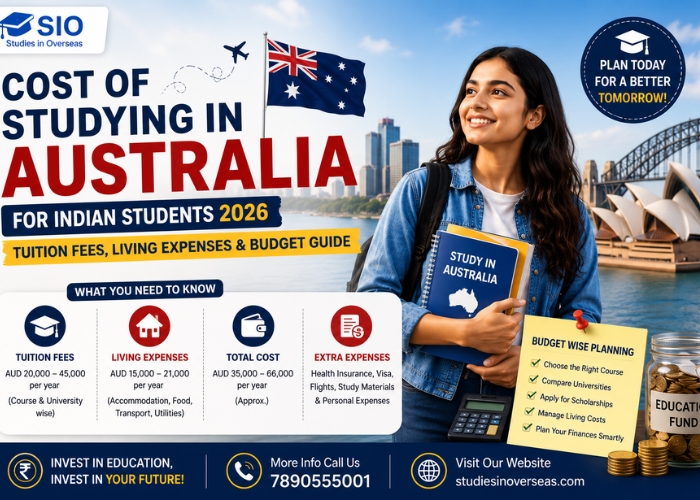
That is when most families realise the cost of studying in Australia for Indian students is not only about tuition. It includes rent, food, health insurance, visa charges, flights, books, rental deposits and many smaller expenses that quietly add up.
A student may budget for the university and still fall short after landing. It happens.
This 2026 guide breaks the numbers into practical parts. No confusing finance talk. Just a realistic look at tuition, living expenses, the Australia student visa cost, postgraduate fees and ways to build a safer budget.
What Decides Your Australian Study Budget?
There is no single price for an Australian education.
The final cost of studying in Australia depends mainly on:
- Your university or education provider
- Your subject and level of study
- Your course duration
- The city and campus you choose
- Your accommodation and lifestyle
A business degree at a regional university can cost much less than engineering, health science or law at a major city institution. Sydney and Melbourne may also need a bigger lifestyle budget than several smaller cities.
So, one student’s budget cannot simply be copied by another.
The study in Australia cost must be calculated for your exact course, intake, campus and living plan. Not from an old YouTube video. Not from your cousin’s 2022 budget either.
Australia University Fees for Indian Students in 2026
Let’s begin with tuition.
For basic planning, undergraduate courses may commonly range from around AUD 26,000 to AUD 60,000 per year. Postgraduate programmes can also vary widely, from comparatively affordable options near the lower end to premium programmes above AUD 60,000 annually. Medicine, dentistry and specialised health courses may cost more.
These are broad planning estimates. Not fixed prices.
The official Australia university fees for Indian students should always be checked on the exact course page and in the offer letter. Universities may review fees each year, so the second year can become more expensive than the first.
Before accepting an offer, ask for:
- Annual tuition
- Estimated total tuition for the complete course
- First deposit amount
- Possible yearly fee increases
- Student Services and Amenities Fee
- Laboratory, equipment or placement charges
The overall budget becomes easier to manage when the family sees the full course bill before making the first payment.
Undergraduate Study in Australia Cost
A bachelor’s degree generally takes three years, although engineering, honours and some professional programmes take longer. Suppose the annual tuition is AUD 32,000.
For three years, tuition starts around AUD 96,000 before any annual increase. Add accommodation, visa fees, OSHC, food, travel and academic costs, and the total rises quickly. This is where the study in Australia cost surprises people.
Families often multiply one year’s fee by three. Then they forget:
- Tuition may increase annually
- OSHC may cover the entire visa period
- Rent usually includes an upfront bond
- Flights become expensive during peak months
- Software, books and equipment may be separate
Make a year-by-year budget. One giant rough number is not enough.
Masters Cost in Australia for Indian Students
Postgraduate study is extremely popular among Indian applicants.
A master’s programme usually takes one to two years, depending on the subject and the student’s previous qualifications. The masters cost in Australia for Indian students may begin around AUD 26,000 annually at selected affordable providers and rise beyond AUD 60,000 at premium universities or in high-cost disciplines.
Never ask only, “How much is a master’s in Australia?”
Ask, “What is the complete fee for this exact master’s at this campus?”
The masters cost in Australia for Indian students should include:
- Tuition for the full programme
- OSHC for the required period
- Visa and documentation charges
- Living expenses
- Software and course materials
- Placement or internship expenses
- An emergency reserve
Some universities quote an annual fee based on a standard study load. Extra units, repeated subjects or an extended course duration can increase the total. Small detail. Big bill.
How Master’s Fees Change by Subject
Postgraduate tuition can look very different across subjects.
Business and management courses cover a wide fee range. IT, cybersecurity, artificial intelligence and data science often sit in the middle or upper bands. Engineering may be expensive because of laboratories, technical facilities and specialised teaching.
Public health may be reasonably priced at some regional institutions, while clinical and specialised healthcare courses can cost much more.
Compare the total course tuition rather than only the first-year figure. This gives a more honest picture of the masters cost in Australia for Indian students and prevents a nasty surprise during the second year.
Australia Student Visa Cost in 2026
From 1 July 2026, the base application charge for the Student visa, subclass 500, starts from AUD 2,500 for most applicants unless a concession or exemption applies. The Australia student visa cost is now a serious part of the budget.
And the application fee is only one part. Your visa-related spending may also include:
- Medical examination
- Biometrics, if requested
- Police clearance
- English-language test
- Document translation or certification
- Overseas Student Health Cover
The visa-related total can increase when a partner or children are included. Family applications involve additional charges and financial responsibilities. Also, paying the fee does not guarantee approval. Sounds obvious. Still worth saying.
Visa Fee and Financial Capacity Are Not the Same
Students often confuse these two. The visa application charge is what you pay to lodge the application. Financial capacity is the evidence showing that you can support your study and stay. Depending on the application, students may need to show access to funds for tuition, travel, living expenses and relevant family costs. The money should be genuine and properly explained. Do not arrange funds for one day simply to create an impressive bank statement. A neat application is good. A believable application is better.
OSHC and Other Mandatory Expenses
International students generally need Overseas Student Health Cover for the required period of their stay. The price depends on the insurer, course duration and whether the policy is for a single student, couple or family. Basic OSHC usually helps with doctor visits, some hospital care, ambulance services and limited medicines. Dental, optical and physiotherapy may not be included. Keep OSHC as a separate budget line. Otherwise, your visa planning will look smaller than it really is. The 2026 Student Services and Amenities Fee may also apply, depending on the institution, along with textbooks, uniforms, laboratory items or safety equipment. These are not always huge costs individually. Together, they matter.
Living Expenses: The Part Students Underestimate
Tuition gets the attention. Rent takes the money.
A practical annual living budget for a single student may be around AUD 24,000 to AUD 35,000 or more, depending on the city, housing and lifestyle. This is a planning estimate, not an official visa threshold.
Your regular expenses may include:
- Rent and rental bond
- Groceries
- Electricity and internet
- Public transport
- Mobile plan
- Medicines
- Personal expenses
- Emergency savings
A student paying AUD 350 per week spends more than AUD 18,000 annually on rent alone.
That is why the cost of studying in Australia is strongly influenced by accommodation. A small weekly difference becomes a large annual number.
A Practical First-Year Budget
A student in a comparatively affordable city might plan roughly like this:
| Expense | Approximate amount |
|---|---|
| Tuition | AUD 30,000–38,000 |
| Accommodation | AUD 12,000–20,000 |
| Food and groceries | AUD 5,000–8,000 |
| Transport | AUD 1,200–2,500 |
| Utilities and phone | AUD 1,500–3,000 |
| Visa application | From AUD 2,500 |
| Books and study needs | AUD 800–2,000 |
| Flights and initial setup | AUD 1,500–3,500 |
| OSHC | Varies by policy and duration |
This sample explains why the study in Australia cost cannot be reduced to tuition. A realistic first-year total can cross AUD 55,000. At a high-fee university in Sydney or Melbourne, it may go much higher.
Cheapest Universities in Australia for Indian Students
“Cheapest” sounds simple.
It is not.
The cheapest universities in Australia for Indian students are not always the institutions with the lowest tuition shown on a comparison website. City expenses, scholarships, course duration, accreditation and employment relevance also matter.
A university charging AUD 29,000 in a costly location may be more expensive overall than one charging AUD 32,000 in a lower-cost city.
Selected programmes at Southern Cross University, Federation University Australia, Charles Darwin University and the University of Southern Queensland may offer comparatively accessible fees. But the price changes by course. Always check the official page.
When comparing the cheapest universities in Australia for Indian students, create a table showing:
- Annual tuition
- Full course duration
- Scholarship value
- Estimated rent
- Campus location
- Accreditation
- Placement opportunities
That is a real comparison. Not just a list of names.
Scholarships Can Change the Final Price
Suppose tuition is AUD 36,000 annually. A 20% scholarship saves AUD 7,200 per year. Across two years, that could save AUD 14,400, subject to the award conditions. Suddenly, a university with a higher published fee may become the better-value choice.
This is why the cheapest universities in Australia for Indian students should be compared after scholarships are applied.
Check whether the scholarship:
- Covers one year or the full course
- Requires a separate application
- Depends on maintaining certain marks
- Is available to Indian students in 2026
- Reduces the deposit or later tuition payments
Do the maths before celebrating the headline.
Total Cost of Studying in Australia for Indian Students
For a two-year postgraduate degree, a broad budget may include:
- Tuition of roughly AUD 52,000 to AUD 120,000 or more
- Living expenses of roughly AUD 48,000 to AUD 70,000 or more
- Visa, OSHC, flights and setup expenses
- Academic and emergency costs
The final amount can therefore vary massively. A carefully planned regional option may be far more affordable than a premium course in a major city. The postgraduate total is shaped by both the course and the lifestyle. Both must be planned.
Can Part-Time Work Cover the Budget?
Part-time work can help with groceries, transport or part of the rent. It should not fund the entire degree.
Student visa holders can generally work up to 48 hours per fortnight while their course is in session, subject to visa conditions. Jobs are not guaranteed, and finding one may take time.
Calculate the study in Australia cost assuming no work income for the first few months.
Strict? A little.
Safer? Definitely.
How to Reduce Your Budget Without Choosing a Bad Course
Students sometimes chase the lowest tuition and end up in a course that does not match their career. Don’t.
Reduce expenses through smarter choices:
- Compare regional and metropolitan campuses.
- Apply early for scholarships.
- Choose shared accommodation.
- Cook most meals.
- Use student discounts.
- Buy second-hand books where suitable.
- Track weekly spending.
- Keep an emergency fund.
- Compare full course duration.
- Avoid unnecessary course changes.
The cheapest universities in Australia for Indian students may offer excellent value, but the right course should still come first. Cheap and unsuitable is not a saving.
Common Budgeting Mistakes
The first mistake is converting every fee into rupees using one fixed exchange rate. Currency values move. The second is ignoring annual tuition increases. The third is forgetting visa fees, OSHC and the rental bond. The fourth is assuming part-time income from the first week. The fifth is comparing tuition without considering the cost of the city. Another mistake is calculating only one academic year for a two-year master’s programme. And finally, families sometimes spend every available rupee on the university deposit. Keep emergency money. Always.
Frequently Asked Questions
1. What is the average cost of studying in Australia for Indian students in 2026?
The cost of studying in Australia for Indian students depends on the course, location and lifestyle. A first-year budget can exceed AUD 55,000 after tuition, living costs, visa charges, OSHC, flights and setup expenses are added.
2. What is the Australia student visa cost in 2026?
The base Australia student visa cost starts from AUD 2,500 for most subclass 500 applications lodged from 1 July 2026, unless an exemption or lower charge applies. Medicals, insurance and documentation are separate.
3. What is the masters cost in Australia for Indian students?
The masters cost in Australia for Indian students may range from around AUD 26,000 to more than AUD 60,000 per year in tuition. The total depends on programme length, university, city and lifestyle.
4. How should I compare Australia university fees for Indian students?
Compare the Australia university fees for Indian students for the complete course, not only the first year. Add scholarships, annual increases, living expenses, OSHC and extra academic charges before deciding.
Conclusion
Australia is not a low-cost study destination. But it can be planned well.
Start with the complete course fee, not the deposit. Add rent, food, OSHC, flights, books and the Australia student visa cost. Keep room for exchange-rate changes and yearly fee increases.
Tuition varies sharply between subjects and institutions. For postgraduate applicants, the masters cost in Australia for Indian students should be calculated for the complete programme.
Compare scholarships. Compare cities. Compare actual living expenses. A realistic budget does not make the dream smaller. It makes the dream safer.